Today I finished up this nice case. The upper right first molar tooth was broken down and non-restorable. I first extracted the tooth and placed a bone graft. Following 3 months of healing we placed a Zimmer-Biomet 3i titanium dental implant. Then after allowing 3 months for the dental implant to isseointegrate, placed the computer scannable Encode healing abutment. Then took the final impression and delivered the screwed retained implant crown.
The dangers of snoring
More than 80 million North Americans snore. Taking into account the snorer’s spouse and children, as many as 160 million people are negatively affected by snoring. And snoring doesn’t merely interrupt your sleep cycle. The struggle for breath can result in soaring blood pressure, which can damage the walls of the carotid arteries and increase the risk of stroke. At certain levels of severity, complete blockage of the airway space by the soft tissues and the tongue can occur. If this period of asphyxiation lasts longer than 10 seconds, it is called Obstructive Sleep Apnea (OSA), a medical condition with serious long-term effects.
What causes snoring?
During sleep, muscles and soft tissues in the throat and mouth relax, shrinking the airway. This increases the velocity of airflow during breathing. As the velocity of required air is increased, soft tissues like the soft palate and uvula vibrate. The vibrations of these tissues result in “noisy breathing” or snoring.
Surgical techniques used to remove respiration-impairing structures have shown only moderate success rates (20 to 40 percent). For the majority of snorers, the most affordable, non-invasive, comfortable and effective snoring solution remains a dentist-prescribed, oral snoring preventative device such as Silent Nite.
How Dr. Gentry can help you with a Silent Nite Slide-Link appliance
Silent Nite sl is a custom-fabricated dental device that moves the lower jaw into a forward position, increasing space in the airway tube and reducing air velocity and soft tissue vibration. Special connectors are attached to transparent flexible upper and lower forms. The forms are custom laminated with heat and pressure to the dentist’s model of the mouth. The fit is excellent and comfortable, permitting small movements of the jaw (TMJ) and allowing uninhibited oral breathing.
Patient wearing the anti-snoring applianceInstructions and connectors to vary jaw position
This video is actually for dentists, and explains all about the anti-snoring device.
This patient came in to my office having broke off his upper right front tooth leaving only the root. This was a challenging case because his other upper front teeth had old crowns on them with receded gums. This space was also larger than the width of the other incisors. I would have liked to replace all his old crowns at the same time so I could make everything perfect and even, but he just wanted me to restore only this broken off tooth. It turned out pretty nice. Since he has a low lip line, he only shows half of the upper teeth anyway when he smiles. My implant tooth actually looks better than his other teeth. This is how I did it:
fractured off central incisorx-ray image of rootroot extracted and implant placedcustom abutment screwed into implantimplant crown cementedhappy patientimplant and custom abutmenttorque wrench, crown, screw, custom abutmentcomputer design scans
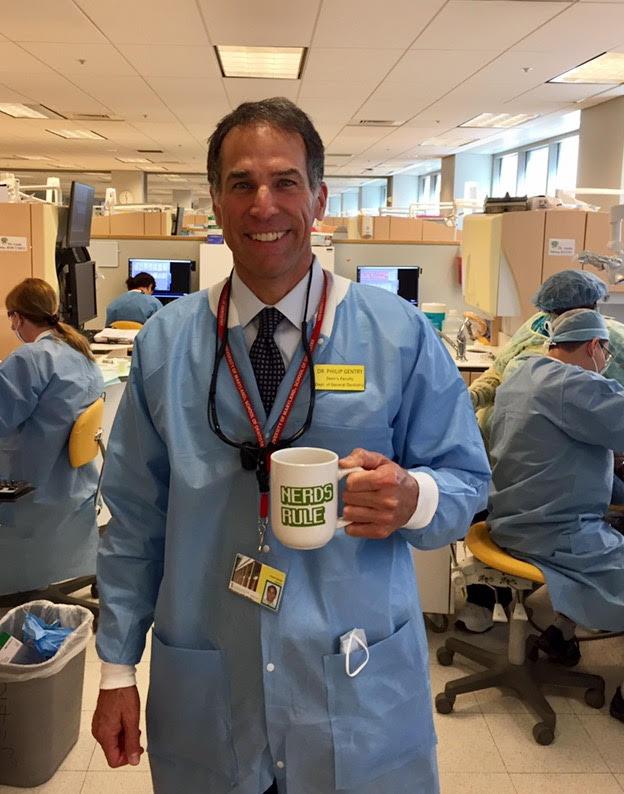
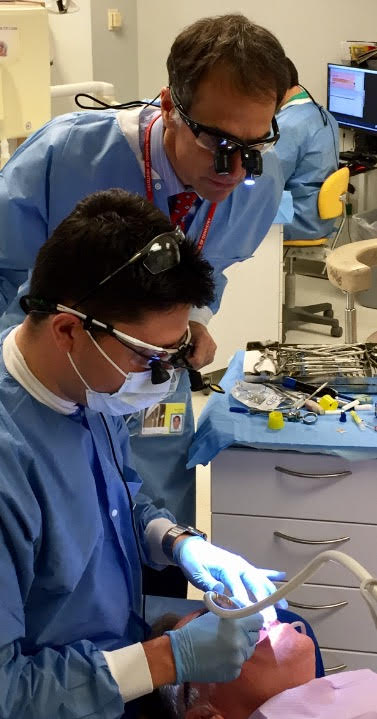
Teaching and supervising at the University of Maryland School of Dentistry. We have the most awesome, amazing, and smart young dentists here in The Advanced Education in General Dentistry Department. I’m proud to say the future of the dental profession is in good hands :-)))
Dr Gentry teachingDr. Gentry with Dr. Mark Reynolds, Dean of The University of Maryland School of Dentistry
This patient chipped his front tooth on a kitchen cabinet door. I quickly and painlessly repaired it with a bonded composite restoration. Here’s the before and after photos. Looks good as new.
This patient’s lower teeth were worn down from years of grinding and clenching. We discussed crowning all the lower teeth, but I wanted to try bonding composite to the tops of the teeth to build them back up. He will eventually wear this away, but it’s easy for me to add to and re-bond the teeth as he wears them down over the years. I also made him a nightguard to wear when he sleeps to protect the teeth.
The first two patients I saw today chipped the same front right central incisor biting into a chicken bone. The third one chipped her lower right incisor biting into a sandwich. The last patient grinds his teeth and fractured the edge off his upper left central incisor. I restored each these teeth in about a half hour, for each one, with bonded ceramic composite restorations. Here are the before and after photos taken 30 minutes apart.